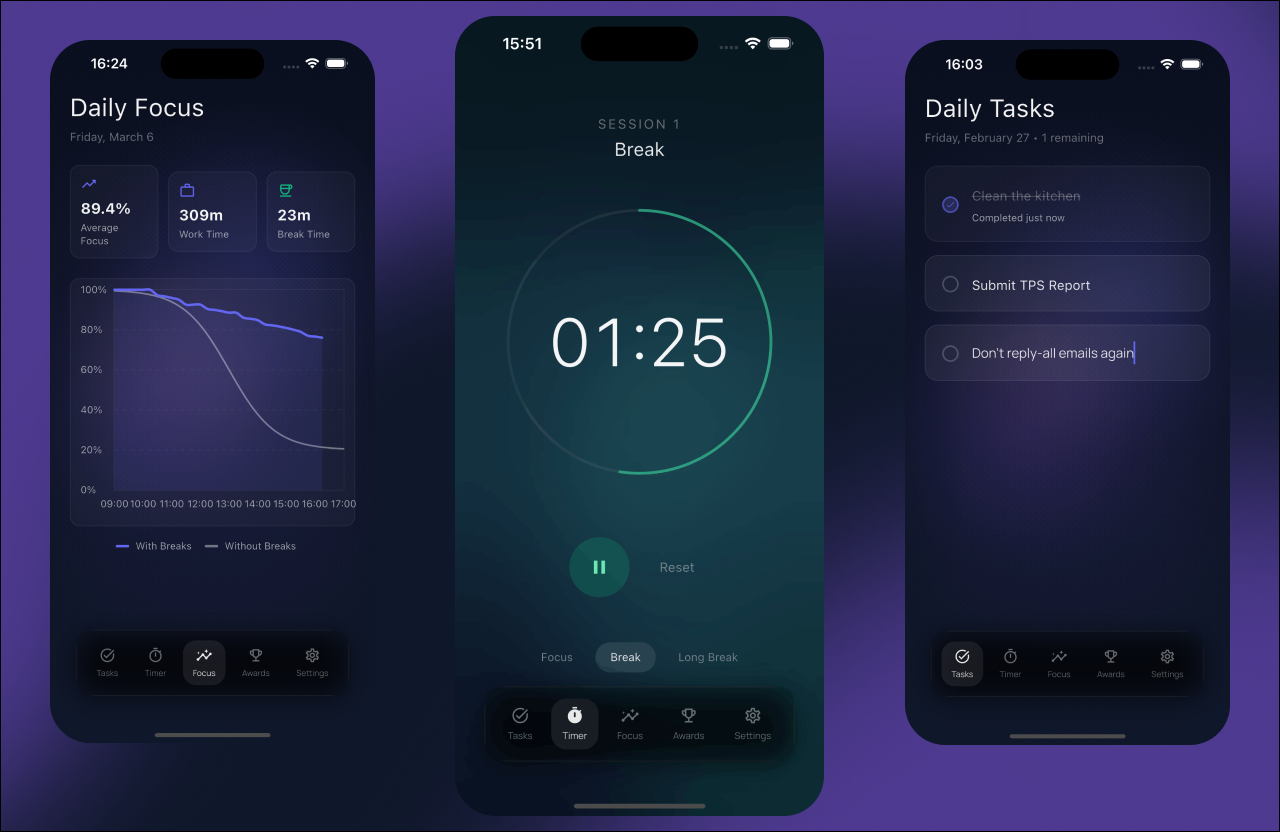


Focus Rise is a productivity app that pairs a customisable Pomodoro timer with focus tracking, goals, and achievements. We designed, built, and launched it on the App Store in four weeks during an internal Shape hackathon.
The point was not to produce a demo. We wanted to see how far one developer could take a real product when AI is used properly, and where experience still decides the result.
Where Focus Rise Started
Most Pomodoro apps count down and stop there. We wanted one that helped people understand their focus, not just measure it.
The first release needed to:
- Make focus sessions and breaks easy to run and adjust
- Show the difference between focused and unfocused time
- Build habits through goals, streaks, and achievements
- Explain its value in the first 30 seconds
A four-week deadline meant deciding what mattered and cutting the rest. That is the same discipline behind our Product Accelerator, where scope is fixed early so delivery stays predictable.
What Shape Delivered
Scope before code
We mapped the screens, data, and user journeys before building anything. Doing this first is what stops an AI-assisted build becoming a pile of disconnected features, and it is why we start every client project with discovery rather than a feature list.
A design direction to build against
Focus Rise uses a dark-mode-first interface with soft gradients, minimal layouts, and editorial typography. We moved from hand-drawn wireframes to higher-fidelity screens in Figma Make, then wrote a design sheet covering colour, type, and spacing.
Deciding how the product should look and behave before development is cheap. Changing it afterwards is not.
Development with clear specifications
We wrote three short documents before building: a backend plan, an API contract, and a frontend guide covering conventions and screen behaviour. These turned the plan into small tasks AI could implement and a developer could review.
The app itself is built in Flutter, so one codebase covers the interface, animations, and timer states. AI produced first drafts quickly, but every output was reviewed. Generated code often over-complicates things or misses edge cases, so knowing what good looks like remained the deciding factor.